
Magnetic Particle Inspection
Eleven videos that explain the magnetism behind CSWIP 3.1u and 3.2u MPI questions. I did not make them. I picked them, put them in teaching order, and wrote under each one what the exam wants you to take from it.
Video by video, with the exam angle
Each video teaches the concept. The line under it tells you how that concept turns up in the exam and where divers lose the mark.
Magnetism basics

Exam angle. Every MPI method starts here. Pass a current through a conductor and a magnetic field forms around it. No current, no field. The exam wants you to link the two.

Exam angle. The field around a straight wire runs in circles around it. Push current through a steel bar and the same thing happens inside the bar. That circular field is what finds cracks running along the bar.

Exam angle. Thumb along the current, fingers curl with the field. You use this to predict which way the field runs, and so which cracks it will show. A field only reveals cracks that cut across it.

Exam angle. Same rule, second explanation. Watch both if the first did not land. The exam tests the outcome, not the rule: a longitudinal field finds transverse cracks, a circular field finds longitudinal cracks.
Why steel stays magnetised
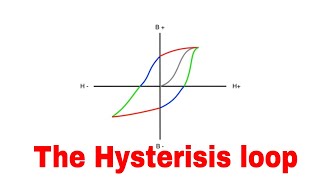
Exam angle. Steel keeps some magnetism after the current stops. That is residual magnetism, and the loop shows it. It is the reason a part must be demagnetised after inspection, and the reason a residual technique works at all.
The MPI method

Exam angle. This is the video I use in the theory course. Magnetise the part, a crack forces the field out of the surface, iron particles gather in that flux leakage. Surface and near-surface cracks only, and only on ferromagnetic steel.

Exam angle. A second full walk through of the method with the classroom terms. Know the sequence: clean, magnetise, apply particles, inspect, demagnetise. Miss the clean step and the particles cannot sit where the leakage is.

Exam angle. The yoke is the tool a diver actually carries. The field runs between the two legs, so cracks across that line show and cracks along it may not. That is why you inspect twice, with the yoke turned ninety degrees.
Checking the field and finishing the job

Exam angle. The strip proves the field is strong enough before you trust a clear result. No indication on the strip means no valid test. The exam calls this a sensitivity or field indicator check.

Exam angle. The part must be demagnetised afterwards. Residual magnetism attracts debris, upsets later welding and can deflect an arc. Know that the field is reduced step by step, not switched off in one go.
MPI underwater
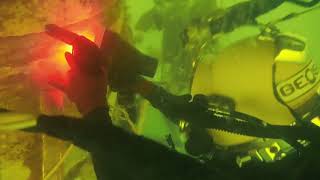
Exam angle. The same method with the diver's problems added. Cleaning to bare metal, fluorescent particles under UV light, and the strip check all matter more when the visibility is poor. Doing MPI underwater is 3.2u work. For 3.1u you need what it is, what it finds and its limits.
The course is the exam practice
These videos explain the magnetism. Doing MPI underwater is 3.2u work, and the 3.2u exam tests it hard. The NDTPrep 3.2u Exam Bundle drills it with Q&A and Flashcards until it sticks.
The videos on this page belong to their creators. I have not edited them. My notes are my own reading of the CSWIP syllabus and are not endorsed by the video makers.