
Ultrasonic Testing and Thickness Gauging
Fourteen videos that explain the sound physics behind CSWIP 3.1u and 3.2u ultrasonic questions. I did not make them. I picked them, put them in teaching order, and wrote under each one what the exam wants you to take from it.
Video by video, with the exam angle
Each video teaches the concept. The line under it tells you how that concept turns up in the exam and where divers lose the mark.
Sound and crystals

Exam angle. Three words the exam uses without explaining. Frequency is how many pulses a second. Wavelength is the length of one pulse in the steel. Higher frequency means shorter wavelength, which finds smaller defects but does not travel as far.

Exam angle. This is the piezoelectric effect. Squeeze the crystal and it makes a voltage. Put a voltage on it and it moves. One crystal in the probe does both jobs: it makes the sound and it hears the echo.
The pulse-echo principle

Exam angle. Send a pulse, wait for the echo, time the gap. That is pulse-echo, and it is what every diver thickness meter does. Know it needs only one side of the steel. Through-transmission needs two probes on two sides.

Exam angle. Watch for couplant. Sound will not cross an air gap because steel and air have a huge acoustic impedance mismatch. Topside you use gel. Underwater the seawater is the couplant, which is why UT suits divers.
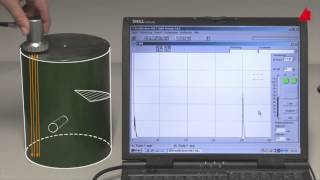
Exam angle. The A-scan display. Height is echo strength, left to right is distance. Find the initial pulse, the flaw echo, and the back-wall echo on the screen. The exam will describe that picture in words and ask what it shows.

Exam angle. A real inspector on real steel. Notice the surface prep and the calibration block before any reading is taken. A reading from an uncalibrated set proves nothing, and the exam knows it.
Thickness gauging

Exam angle. A digital thickness meter shows one number: the distance to the strongest echo. On clean steel that is the back wall. On a laminated or badly pitted member it can lock onto a flaw and give a false thickness. An A-scan shows both echoes so you see the trap.
Dead zone and near zone

Exam angle. The near zone is where the beam is still forming. You can see echoes there but their height does not match defect size. Read thickness in the near zone if you must, but size flaws in the far zone.

Exam angle. All three zones in one picture. Dead zone under the probe, near zone where the beam forms, far zone where it spreads and settles. The exam treats dead zone and near zone as separate ideas. Keep them apart.
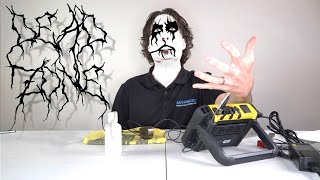
Exam angle. The dead zone is the blind spot where the crystal is still firing and cannot listen. About one to three wavelengths deep. Anything in it is missed. A twin-crystal probe shrinks it, which is why thin-wall work uses one.
Angle beam and finding cracks

Exam angle. A Perspex wedge tilts the beam. At the wedge-to-steel boundary the sound refracts and mode converts from a longitudinal wave to a shear wave. Snell's Law sets the angle. That is how a probe on the plate finds a crack in the weld.

Exam angle. Watch the screen, not the probe. A crack echo appears before the back wall and moves as the probe moves. Learn to read that movement. It is the difference between an indication and a guess.

Exam angle. Sizing, not just finding. Peak the echo, then move the probe until the echo height halves. That is 6 dB down and marks the edge of the flaw. Sizing is mostly 3.2u work, but 3.1u expects you to know searching and sizing are different jobs.
Putting it together

Exam angle. A full run from calibration to report. Use it as a revision pass. If any word in it is new after the videos above, go back and find it. The exam expects the vocabulary, not the hands-on skill.
The course is the exam practice
These videos explain the sound physics. The NDTPrep 3.1u Interactive Theory course puts it in the order the syllabus uses, with the diagrams, the plain-English explanations, and a quiz at the end of every module. Then the Q&A and Flashcards drill it until it sticks.
The videos on this page belong to their creators. I have not edited them. My notes are my own reading of the CSWIP syllabus and are not endorsed by the video makers.